What You Should Know About Sciatica
WHAT YOU SHOULD KNOW ABOUT SCIATICA
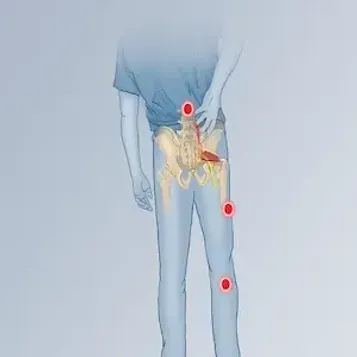
Sciatica is neurological leg pain caused by irritation or compression of the sciatic nerve root in the lumbar spine.
What are the symptoms of sciatica?
Characteristic symptoms include:
- Burning or shooting pain radiating from the lower back through the buttock into the leg
- Tingling and numbness along the nerve path
- Leg muscle weakness
- Symptoms typically affect one side of the body
- Worsening when sitting, bending, or turning
- Possible improvement when walking or lying down
Main causes of sciatica
- Lumbar disc herniation — most common cause (pressure on the nerve root)
- Spinal stenosis — narrowing of the spinal canal
- Degenerative disc disease — disc loses height and compresses the nerve
- Spondylolisthesis — slippage of one vertebra forward relative to another
- Muscle spasms — especially the piriformis muscle (piriformis syndrome)
- Sacroiliac joint dysfunction
The sciatic nerve
The sciatic nerve is the thickest nerve in the body — as thick as a thumb! It is formed by the union of nerve roots L4, L5, S1, S2, and S3. It passes through the gluteal region and extends down the entire leg to the foot.
Course of sciatica
The outcome varies depending on the cause:
- Acute sciatica (up to 4 weeks) — most commonly resolves spontaneously
- Subacute (4–12 weeks) — requires physical therapy
- Chronic sciatica (more than 12 weeks) — requires structured rehabilitation
How long does sciatica last?
Most patients experience improvement within 4 to 6 weeks of conservative treatment. It is important to note that tolerating and waiting is not a strategy — without treatment, sciatica can become chronic.
Treatment of sciatica
Conservative (recommended as the first step):
- Manual therapy — lumbar segment mobilization
- Spinal decompression — reduces pressure on the nerve root
- Dry needling — relaxation of piriformis and paraspinal muscles
- Physical therapy — TENS, ultrasound, laser
- Kinesiotherapy — pain centralization exercises (McKenzie), core muscle strengthening
When to seek immediate medical attention?
If problems with bladder or bowel control appear, or if there is sudden increase in leg weakness — these are signs requiring urgent medical assessment.
Is sciatica serious?
In most cases, sciatica is not life-threatening, but it can be very disabling. Early intervention prevents chronification and speeds recovery.

Questions or want to book an appointment?
The initial examination is free. Call us or visit the contact page.
062 8558 510